Why Fiberglass Filter Production Requires Professional Automated Production Lines
May 13, 2026
“
"Our 300mm High-Temperature Fiberglass Folding Production Line turns precision for heat-resistant media into real-world results: less material waste, stable high output, and greater production efficiency for your filter manufacturing. This isn’t just a machine—it’s a strategic asset built to scale your quality, meet strict HEPA/ULPA standards, and secure your growth in high-end industrial and automotive filtration markets."
Nina Peng - Operations Manager
In high‑efficiency filtration, industrial high‑temperature purification, automotive painting, semiconductor cleanrooms, and pharmaceutical fields, fiberglass filters — especially high‑temperature resistant models — are irreplaceable core components. Their material properties, structural precision, and performance stability cannot be guaranteed by manual operation or simple machinery. Only professional automated production lines can meet the strict requirements of mass production.
1. Fiberglass Filter Media Is Too Special for Ordinary Equipment
Unlike PP, non‑woven, or paper filter materials, fiberglass has unique characteristics:
Brittle, fragile, easy to fray and produce powder
High rigidity, poor resilience, sensitive to folding force
Requires uniform pleats, consistent spacing, and flat forming
Manual or simple equipment often causes:
Uneven pleats, distorted angles
Material breakage, high scrap rates
Unstable filtration area and excessive air resistance
Professional automated lines protect fiberglass throughout the entire process — feeding, tension control, pre‑slitting, marking, pleating, and conveying — ensuring zero damage and stable forming.
2. Precision Determines Performance: Simple Machines Cannot Make HEPA-Grade Filters
Filtration efficiency, dust-holding capacity, air resistance, and service life all depend on pleating precision.
Professional automated lines provide three critical advantages:
Full servo control: Precise adjustment of pleat height, speed, and pressure with minimal error
Dual servo knife pleating: Ideal for brittle fiberglass, forming straight, firm pleats
Integrated slitting & pleating: One‑step processing to eliminate secondary damage and deviation
In contrast, products from basic machines:
Fail to meet HEPA/ULPA standards
Show unstable performance between batches
Cannot pass leakage or high-temperature reliability tests
3. High-Temperature Fiberglass Filters Require Specialized Production Lines
High-temperature fiberglass filters are widely used in:
Automotive paint booths (200°C+)
New energy battery baking
Semiconductor & pharmaceutical cleanrooms
Industrial boilers, kilns, waste incineration
These applications demand:
Heat-resistant fiberglass media
High-temperature adhesive and support lines
Stable pleating under high-temperature conditions
Ordinary machines often cause:
Pleat deformation
Layer separation
Sealing failure
Poor performance in high-temperature environments
Only specialized high-temperature automated lines ensure qualified output.
4. Mass Production & Consistency Win Global High-End Markets
For automotive, semiconductor, new energy, pharmaceutical, and export orders, consistency is mandatory:
Uniform pleat depth & spacing
Stable air resistance & efficiency
Pass leakage and strength testing
Traceable process parameters
Automated lines deliver:
24-hour stable running
High output, low labor cost
Batch-to-batch consistency
Easy access to international certifications & high-end markets
Our Recommended Solution
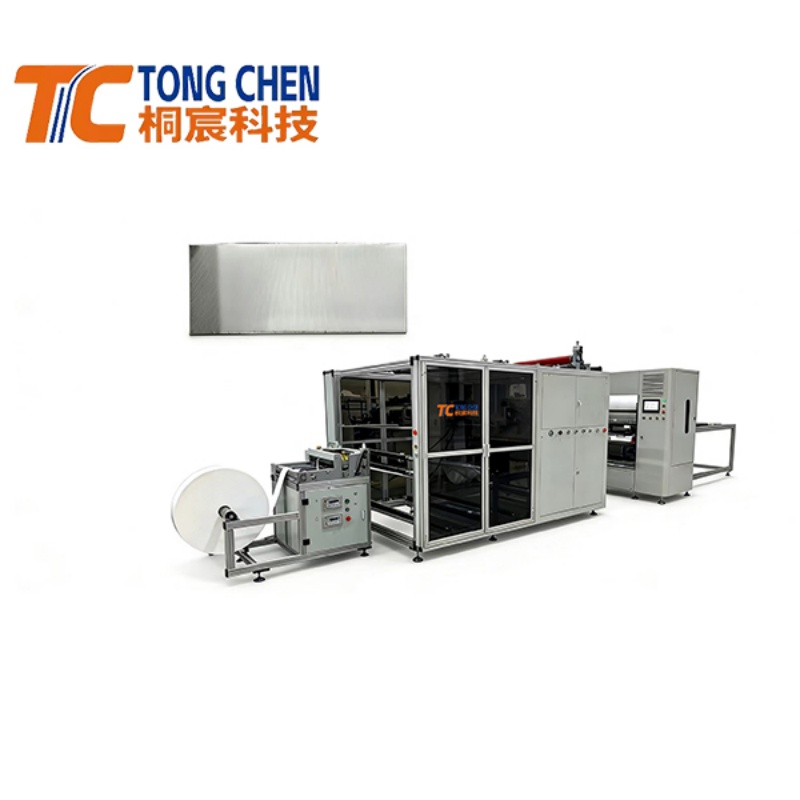
Tongchen 300mm High-Temperature Non-Partition Fiberglass Folding Production Line
Designed specifically for high-temperature resistant fiberglass HEPA/ULPA filters, this line solves all critical production pain points.
Key Features
Pleat height: 20–300mm adjustable
Max working width: 1000mm
Pleating speed: 0–60 folds/min, stepless adjustable
Dual servo knife system for precise, non-damaging pleating
Automatic synchronous control for top/bottom lines and filter paper
Aluminum press plate specially designed for fiberglass
High-temperature resistant structure for heat-resistant media
Stable, durable, low failure rate, easy operation
Main Applications
Automotive painting line high-temperature filtration
Semiconductor & electronics cleanrooms
New energy battery manufacturing
Pharmaceutical aseptic & high-temperature sterilization areas
Industrial kilns, boilers, waste incineration flue gas treatment
Conclusion
Fiberglass filters — especially high-temperature resistant models — are high-performance components that demand precision manufacturing.
For stable quality, high output, low scrap rates, and access to global high-end markets, a professional automated production line is not an option — it is a necessity.
Tongchen’s 300mm High-Temperature Non-Partition Fiberglass Folding Line gives you the technology to produce premium high-temperature fiberglass filters efficiently and reliably.
Read More